New Principles for Public Policy

Malcolm Fraser famously remarked, as the tumult of the Whitlam years neared its end, that he wanted Australians to feel they could turn to the sports pages first when they read the newspaper. In other words, that political life and public policy would once again become sufficiently stable and predictable — even ‘boring’ — that the news section would no longer be a priority.

That is hardly the situation that we find ourselves in currently, with each day bringing new developments on the policy scene, many of them unexpected or unwanted. Fortunately, our papers also feature a number of excellent satirical columnists, whose writings can provide a welcome diversion and sometimes even catharsis. ‘The Mocker’, ‘Jack the Insider’ and ‘Brown Study’ are great examples, providing both laughs and insights.

Satirists have had a field day recently, given the rich vein of unintentionally comedic material to draw from. In many cases, they need do little more than embellish what is observed. Recent takedowns of our political leaders have been especially good, like Jack the Insider’s parody of the Treasurer’s fondness for jingoistic alliteration (‘Grim Jim’s Spin’, The Australian, May 20, 2026).

In a typically droll piece in this week’s Australian Spectator, Neil Brown (former politician and barrister) inspired by how the controversial tax changes in the Budget were developed and presented to the public, suggests that policy-making under Labor now conforms to two new principles.

The first of these he calls the ‘Principle of 51’. Based on the Prime Minister’s curt response to a journalist pressing him on whether he would rule out making changes to the Capital Gains Tax and negative gearing — “Yes! How hard is it?! For the fiftieth time…” — it states that no promise can be counted on until it has been made at least fifty-one times. This principle clearly has much wider application than taxation policy. It would also encompass earlier promises like those repeatedly made about electricity prices, or not reinstituting industry-wide union bargaining, etc.

The second is the ‘Principle of the Changed Position’. As you will recall, Albanese denied that he broke his promise on taxation, declaring that after the election he had simply ‘changed his position’. The sense was that this was a perfectly normal thing to do. After all, Labor had changed its position on a key tax promise in its first term as well. Attempting to draw a parallel with John Howard’s own change of mind on the GST back in 1999 proved unfortunate, however, as it revived memories of that reform having been taken to a hard-fought election (against relentless Labor opposition).

Neil Brown stops at these two new principles, but his approach could be taken further.

For example, increasingly on display is the ‘Act first, consult later Principle’; a variant of which is ‘legislate first, work out the details later’. These have been evident for the superannuation ‘reforms’ as well as for the tax changes announced in the Budget, for which Treasury has again resorted to ‘policy-based evidence’. (Key aspects of the super ‘reforms’ are still unresolved, with the starting date for the new regime being just a few weeks away.) An earlier example was the retrograde industrial relations changes that shocked business leaders invited to Labor’s ‘Jobs Summit’. (Memo to business: Labor is the political arm of the Union movement.) The goal, successfully realised, was to pre-empt objections that might have carried weight with the public.

Then one could add what might be called the ‘Digging-in Principle’ to cover the increasing tendency never to admit error, and rarely to change course, in the hope that most people will have forgiven or forgotten by election time. (This might also be called the ‘Andrews Manoeuvre’, based on its successful application in Victoria.) It was fully on display in the Treasurer’s proposal to tax the unrealised capital gains in larger superannuation accounts. Chalmers persisted with this proposal, despite vocal and well-founded opposition from all sides, until the politics had become so fraught that the PM felt obliged to step in. A similar phenomenon is playing out with the Treasurer’s/Treasury’s misguided tax changes announced in the Budget, though whether the PM intervenes this time round remains to be seen.

Where politician’s statements are at variance with evidence or logic (or both) there may also be a place for what could be called the Costanza Principle. Drawn from the Seinfeld comedy TV show, this states that ‘a person is not telling a lie if that person believes it to be true’. For example, it cannot be ruled out that the PM and at least some Ministers really did believe that electricity bills would fall by $275. Indeed Minister Bowen may truly think that ‘renewables are the cheapest source of energy’, or even that ‘the sun and the wind don’t send us a bill’. Moreover, the Treasurer might actually believe that his big spending and taxing budget will help young people. Further, the Government may think it can solve the demand-driven housing crisis without reducing immigration. (It is even possible that Albo was sincere when he denied falling off the stage on national TV.)

It is said that a politician who can fake sincerity has got it made. So there is that to consider. However if the false beliefs and delusions are genuinely held, it would be a sad reflection on the state of the public service, whose primary function is to ensure that ministers are properly informed when making policy.

To the extent that the new policy principles, satire aside, are reflective of what is actually happening, our country has a rocky road ahead of it. There are signs the electorate may be waking up to this, with the latest survey showing the public’s trust in government reaching an all-time low. It may also be seen in the unprecedented support for Pauline Hanson’s One Nation party, which, abstracting from questions of policy merit, is at least known for being upfront and consistent on issues that matter to people.

Public sector up, productivity down

There has been a pronounced ramping-up of the public service in Australia under current (and a recent) Labor governments, even by historical standards. That this has coincided with weak productivity nationally cannot be dismissed as correlation without causation. In fact, what is happening to the public service is playing a more central role in this country’s productivity malaise than generally thought.

The ABS reported a couple of weeks ago that the number of public servants had reached 2.6 million Australia wide. It rose last financial year by 3.6 per cent and by 7.8 per cent in terms of the wage bill — outstripping the private sector in both respects. Indeed, if we widened the definition of ‘public sector jobs’ to include all those funded by the taxpayer, whether or not located within government, we are looking at around 40 per cent of Australia’s workforce. Moreover the trend has been upward, with nearly 80 per cent of the jobs created in Australia over the past few years being publicly funded. As highlighted (ineptly) by the Opposition during the recent election, the Australian Public Service alone increased by nearly 40,000 (one-quarter!) during the Albanese Government’s first term.

Meanwhile, the story on productivity keeps getting worse. The RBA has just announced that it is basing its key projections for the economy on labour productivity growing at a mere 0.7 per cent annually, down from the 1 per cent it had been assuming a few months back. The Treasury reduced its own estimates in the latest IGR from an unrealistic 1.5 per cent to a still optimistic 1.2 per cent. It’s not so long since productivity was growing twice as fast.

Australia’s productivity slump — one hestitates to use the word ‘unprecedented’ — translates to an economy that, as the RBA has observed, is more vulnerable to inflationary pressures, public deficits and debt. More importantly, it is an economy in which real per capita incomes and living standards barely rise. For many they have been falling.

It is a matter of arithmetic that if the public sector grows at the expense of the private sector, overall productivity will be lower. Services in areas such as health, disability and aged care — what collectively the Treasurer calls the ‘care economy’ — have inherently lower productivity and productivity growth than other activities. If anything, their performance has worsened in recent years as remits have widened and workforces have increased. (NDIS employment doubled in three years.) A recent study found that the expanding non-market sector knocked 0.3 percentage points off Australia’s productivity growth rate.

This is not really news, with the PC placing public sector growth first among several contributors to the productivity malaise. However the sector’s role is not confined to the provision of services to the public. A proportion of government employees (one-half federally) have the important role of informing/advising government decisions about policy, regulation and ‘investment’ — decisions that have an impact on other sectors’ productivity. Unfortunately this core public service role has been changing in ways that serve to compound the nation’s productivity problem. While this phenomenon is not new, it has arguably become worse more recently.

It has two inter-related dimensions. The first is the transformation from an ‘independent’ public service, to a ‘responsive’ public service, and now an ‘aligned’ and more submissive one. The Permanent Secretaries (‘mandarins’) who presided over the old public service were not always ‘responsive’ enough to their political masters, particularly when under a new government. Change was needed. But the introduction of fixed-term contracts and performance pay, along with more ‘partisan’ appointments, meant that things got too responsive. Indeed we have reached the point where the public service seems more like an extension of ministers’ offices than an institution impartially serving governments from different sides of politics.

This has resulted not only in less so-called ‘frank and fearless’ advice — I’m not sure there was ever much that was truly ‘fearless’ — but a lot more ‘second-guessing’ in the advice that is offered, with less of it written down. I recall one department head telling me at an ANZSOG event that “of course” different policy options were still being provided to ministers, just “not those that might be unwelcome”. In my experience, these are generally the ones that have most merit.

This has culminated in the ‘co-production’ with ministerial staff of a department’s written/formal advice — something that was ‘verboten’ in former times.

The shift to an increasingly reactive and submissive public service has inevitably made it harder for policy departments to retain quality people and thus to maintain capability. One respected former public servant speaks of an ‘age of incompetence’ in government administration. Evidence for that harsh assessment, unfortunately, is everywhere.

These trends became manifest first in line agencies, where political pressures have tended to be more concentrated. Among the last skittles to fall were state treasuries, leaving the federal Treasury on its own as standard bearer of the public service’s traditional role. Unfortunately, that last skittle, along with the Finance Department, appears to have fallen too. The timing is hard to pinpoint, as it did not happen overnight. The author of a history of the Treasury, with nearly 30 years service there, places its origins largely with the first Rudd Government, when Swan was Treasurer, Chalmers his ‘staffer’ and Parkinson departmental Secretary.

Regardless of its timing, that a more political Treasury is now a fait accompli has serious implications for policy into the future and thus for the future of Australia itself.

In returning to this theme for a private luncheon discussion recently, I was prompted by three news items:

The first was a report that the multi-billion dollar government program to reduce (measured) inflation through subsidised rebates on users’ energy bills, failed to obtain the formal sign-off by the Treasurer required under legislation. This omission, which raised questions about the program’s constitutionality, was ultimately rectified — but not before monies had been expended. Apart from its administrative failure, that Treasury could support such an ‘anti-economic’ scheme, in the lead up to an election, has raised questions about both competence and partisanship.

Second came Chalmers’ high-stakes backdown on the more egregious features of his proposed penalty tax regime for citizens with higher superannuation balances. That a plan to tax unrealised capital gains (paper profits) could have been persisted with by the Treasurer for over two years, in the face of justifiable objections from all sides, suggests that his Department was behind him all the way (if not pushing the idea in the first place).

Thirdly, Treasury’s modelling in support of the Government’s Net Zero policies has been widely criticised for the unrealistic assumptions that its findings depend on. One of the more significant is that the big emitters globally take comparable action to us, rather than the relative inaction or retreat we observe.

In addition to such failures in its own policy domain, Treasury seems to have dropped the ball as an opponent within government of bad policies emanating from other ministries. Observing the Treasurer’s support for Bowen’s costly renewables policies and Bourke’s retrograde industrial relations changes — both of which undermine our productive potential — one wonders what role Treasury has played. It is of course possible that there are briefings against such harmful policies behind closed doors, as Treasury officials sometimes intimate. If so, this has clearly had no influence on a Treasurer who is on the record offering fulsome praise for his department.

Increasing politicisation of the Treasury could be expected to have implications for agencies located within its portfolio, especially those with an economic role. The more ‘political’ it becomes, the more it might be expected to seek to exert influence. I got an early sense of this during the latter part of my time at the Productivity Commission, when I found myself rebuffing queries about where certain sensitive inquiries were ‘heading’. Such pressures could only have increased since then. Indeed greater collaboration with Treasury can be read into the Treasurer’s ‘Statement of Expectations’ for the PC, the first of its kind. Could such efforts succeed? Hopefully not. It would not serve the interests of either party, especially the Productivity Commission, let alone those of the public. That said, proposals by the Commission to restructure corporate taxation in Australia — an area of policy that the Treasury has hitherto kept entirely to itself — will have raised doubts.

Elaboration of remarks to a business luncheon group in Melbourne, November 2025

Roundtable reflections

I have been asked what I think will come out of the Government’s coming Roundtable (variously called the Productivity Roundtable and the Economic Reform Roundtable). The short answer is not much; at least not in terms of reforms that would raise productivity growth and living standards - the ostensible rationale for holding it.

That is not a reflection on the utility of roundtables per se. The Productivity Commission made extensive use of them for its public inquiries and research studies during my time there and no doubt has continued to do so. They can be a useful means of collecting information and testing policy ideas, as well as learning from discussions among parties with different interests and perspectives. Depending on their ‘depth of focus’, they can promote a shared understanding of the issues and even (though less commonly) secure broad agreement about the best ways forward in the national interest.

This particular Roundtable has a number of features that are not conducive to such felicitous outcomes. For a start, the range of topics is open-ended, though with key areas like Industrial Relations unfortunately excluded. Even though the number of attendees is not large, this means there will be limited time to delve into specific issues, with the devil inevitably in the detail. Moreover, the Treasurer has indicated that he is seeking consensus, despite selecting participants from different interest groups with a history of agreeing on not much.

A number of the speakers are known to have views that accord with Labor’s own, however, particularly about renewable energy and the taxation of ‘wealth’. Two federal elections were lost on Labor’s tax policies in the past, which should be grounds for caution, even for a government with such a large majority. However, the blow-out in spending (‘investments’) on social services, renewable energy and the public sector generally, has raised the stakes. With the historically high public spending defended as necessary to meet high public expectations, Australia’s fiscal problem has been framed as primarily a revenue-deficiency one, not excessive (or poor) spending. That immediately rules out reforms (eg to the NDIS) that are much needed.

A positive feature this time, compared to the 2022 Summit — an event that we now know was largely about securing legitimacy for unheralded industrial relations ‘reforms’ — is the presence of the Productivity Commission. As observed previously, the Treasurer recently asked the Commission to undertake anew inquiries on five themes (‘pillars’) it had already reported to him on in 2023. The ‘five year productivity report’ was commissioned by the previous Government and (consequently?) largely ignored or downplayed by this one; or, in the case of IR and climate policy, derided for lack of ‘alignment’ with Labour values.

This time round, the terms of reference constrain what can be said about climate policy and, understandably, the Commission has not included IR as one of its priority areas for reform. By contrast, corporate taxation, which is only briefly mentioned in the five-year report, was signalled early on as a primary focus. I found this rather surprising, given the determination of Treasury in the past to keep the independent advisory body right away from federal tax matters. That the PC’s intention to address this sensitive area — and the radical proposals for ‘reform’ that it came up with — were received with such apparent equanimity by the Treasurer, is even more surprising, at least on the presumption that Treasury kept its traditional distance.

As an aside, I also found it interesting that the requirement for revenue neutrality — which is behind the redistributive nature of the proposed corporate tax changes — is not specifically mentioned in the Commission’s terms of reference or any other formal correspondence from the Treasurer, even if he had made his views plain in public utterances.

The Roundtable session devoted to tax policy is to be led by the current CEO of the Grattan Institute, which has long advocated changes to the taxation of wealth and property that Labor has itself previously supported (but the electorate has rebuffed). This has understandably struck observers as suggesting that the Roundtable may involve the sort of entrapment risk for tax that occurred for IR in the ‘summit’. This has of course been denied, with the PM intervening to declare that there will be no tax ‘reforms’ during this term beyond those taken to the election. It goes without saying that this would be a departure from previous experience. Time, as always, will tell.

As a brief comment on the quest for Net Zero, it is becoming more widely appreciated that Australia’s efforts at reducing emissions only matter in a substantive, as opposed to symbolic, sense if others play their part, and that this seems not to be happening for countries responsible for the bulk of global emissions. Some economists’ counter-argument that ‘taxing’ emissions is needed to correct an ‘externality’ nationally, regardless of what other countries do, defies both economic logic and common sense. Whatever actions we choose to take — even prohibitively high carbon taxes that serve to decimate industry — would have hardly any impact on global emissions, let alone on Australia’s actual climate. In cost-benefit terms, what we are doing is essentially all cost, no benefit. A pity this is unlikely to be raised at the Roundtable.

Poor process, poor policy, poor politics..

For anyone who, like me, still clings to the notion that ‘good policy is good politics’, especially if based on ‘good process’, this federal election would have been a particular disappointment. ‘Good’ policies — ones that stand a good chance of making the community better off — were few and far between, with good process rarely apparent.

I believe this played a significant role (alongside various other problems) in the Coalition’s monumental defeat. With a leader who, to put it kindly, lacked charisma, and plenty of seats needing to be won back, the Coalition required a strong policy agenda, one that could persuade the public that a change of Government was warranted. It did not have one.

Many Coalition policies appeared to have been made ‘on the run’ in a reactive rather than proactive way. And without being burdened by much consultation or analysis. They can be grouped under the headings ‘me too!’ or ‘gotcha!’.

In the first category, mainly spending policies, the Coalition either added more money to what Labor was handing out, or fiddled with the detail. This made it hard for the public to distinguish it’s offerings from those of Labor; who, let’s face it, is widely acknowledged as the champion of big spending. So it was easy for Labor to sow seeds of doubt about the Coalition’s commitment. Such doubts would have been reinforced by how late policies appeared and how little effort was put into selling them. Moreover, those front benchers who might have been expected to perform that critical role — and been better at it than the leader — were largely missing in action.

Where real policy differences with Labor existed, they were mainly in the ‘gotcha’ category: intended to exploit Labor’s blindspots or ideological commitments. Fair enough. But at least two of the more politically significant of these — the sacking of Albo’s 41,000 public service recruits and ending work from home — had clearly not been thought through. They required backtracking that left egg on the Coalition’s collective face and made it impossible to convince the electorate that it would be better at policymaking than Labor.

Dutton and Hume diminished the Opposition’s perceived policy credentials further by explaining that the reason for the WFH turnaround was that “we’ve listened to what people say.” That would translate in many minds as, ‘we did not bother to listen beforehand’.

On the ‘sacking of Canberra’ the Coalition got the numbers wrong, again and again. Their errors and mis-steps made it hard to credibly deny that front-line services would be affected, making it not just an issue for Canberra but for the rest of the country too. Eventually asserting, on the back foot, that there would be no forced redundancies, made the infeasibility of the policy even more evident. In any case, ‘natural attrition’ or ‘voluntary redundancies’ are rarely the best way to go — too slow in the first case, too costly in the second, as well as dumbing down the workforce.

It would have been immediately apparent to anyone with knowledge of the public sector that both of these initiatives were bound for trouble. Listening first would have avoided the traps that caused such grief later. In the case of the 41,000, the lack of preparation was no doubt due to the urgent need to come up with savings to cover newly increased spending proposals. But desperation is not a good look for an Opposition trying to win support.

The Coalition’s controversial nuclear policy had elements of both ‘me too’ and ‘gotcha’ about it. It was pretty much an add-on to the Government’s own energy policy, and committed to the same net zero target. But that very target, the global viability of which is now seriously in doubt, made it look problematic in the time frame. That’s apart from the issue of cost, always a focal point for Government attack, but not well handled.

As many have said, as the election approached what the Coalition really stood for became harder to discern from its grab-bag of policy announcements. The exact opposite to Abbott’s winning mantra. In the end, all that Dutton was left with was his petrol price ‘gotcha’ and endless photo opportunities at the bowser. Hardly a good policy, and politically outweighed by not going along with Labor’s (equally opportunistic) tax cut. Better to have held back on some of the extra spending instead.

‘Policy on the run’ is not conducive to building public trust in the policymaker. In uncertain times, the electorate can’t be blamed for sticking with the devil it knew.

GARY BANKS

Policy challenges of our own making

Following an online interview with Joe Kelly of The Australian, that paper published a front-page story by Kelly on 4 March titled ‘Our nation stuck in reverse’. My remarks were also used by the paper for an op ed under the heading ‘IR, energy bungling put brakes on growth’.

These can be googled and read elsewhere. I thought I’d just add here some content that got left out, but still seems worth saying.

The article details the dimensions of policy failure in two key areas of our economy: energy and industrial relations. Once upon a time, our strong comparative advantage in low-cost, reliable energy helped offset the self-imposed disadvantage of our centrally prescriptive and costly system of workplace regulation. But policy actions over the past decade have seen us forfeit the former while exacerbating the latter. This is bad not only for industry competitiveness, but also for economic growth and the living standards of Australians.

When it comes to (real) reform, we know what should be done, and we know what could be done. But actually getting it done is another matter.

On leaving the Productivity Commission back in 2012, I compiled a list of reforms from its past inquiries that still warranted implementing (‘The To Do List’). There were quite a lot. Five years later, the Commission produced an updated list under the title ‘Shifting the Dial’. This had over 20 recommendations as I recall. The Commission observed last year, when doing its latest productivity review, that little had been accomplished. I’d go further and say that if the Dial has shifted at all, it’s shifted in the wrong direction.

So why the failure to achieve reforms that are generally recognised as beneficial? The age-old problem of course is that inevitably they will be opposed by interests who benefit from the status quo. That hasn’t stopped reform in the past, but it seems to be a show-stopper these days.

Blaming the Senate doesn’t cut it in my view. Sure the cross bench is bigger and more assertive. But that just means there’s a need for more effort in making the case and getting the public on board. Instead, the opposite seems to have occurred.

For example, in the case of IR, it was all too obvious that the previous Government’s private hand-holding sessions with the ACTU and BCA would not do the job. At least not if the Government wanted real reform.

The new media and a more political public service have been rightly implicated in the increased politicisation of policy and reform. But having seen what capable, reform-minded leaders can achieve in challenging conditions, I can’t help but think that it has been their absence (from both sides of politics) that has been the critical factor.

If leadership is key, it should not be impossible to turn things around. It’s not as though there isn’t enough material for an ambitious leader to draw on.

A propos, the Productivity Commission’s latest five yearly ‘to do list’ is currently being reviewed by Treasury. and soon due for release. The Treasurer has said it could ‘kick start a conversation’ with the public about reform. That should be encouraging. However his further observation that only a few of the Commission’s 70 or so recommendations aligned with his Government’s objectives is less so. It suggests that the Government’s interests and priorities lie elsewhere.

Redistribution is clearly at the top of the list. That was true also of the Whitlam Government just on 50 years ago. Whitlam understood, however, that to be sustainable, an ambitious socialist program of redistribution needed to be underpinned by a vibrant economy. It’s just that he failed to deliver — in part because of inherent tensions between the way the two objectives were pursued.

It’s hard not to feel that what we are embarked on currently is a case of history repeating itself.

Remarks for the 'Whitlam Era' book launch (National Press Club, Canberra)

Being asked to write a chapter about Whitlam’s ‘assault on protection’ for a book commemorating the 50th anniversary of his Government, was an offer I could not refuse (in a good way). Labor’s historic victory on the 2nd of Dec ‘72 (my 23rd birthday) and Whitlam’s bold moves against The Tariff the following year not only had major implications for Australia’s economy and society, they had a big influence on my own life and career.

I had arrived in Canberra earlier that year to pursue post'-graduate study at ANU, on the advice of Brian Brogan, one of the lecturers in my Honours Year at Monash University (and a key player later in the Tariff reforms). Having been ‘conscripted’ in my second year, the desire to further postpone National Service was, I confess, a prime motivator. (I wonder how many young blokes like me ended up doing more study than otherwise thanks to Conscription?) Fortunately the Draft Board not only accepted my application, but considered two years a reasonable period to complete a Masters Degree. This allowed me to do it part-time concurrently with a full-time junior research position at the Tariff Board, which at that time was striving to build up its modelling capabilities.

Whitlam’s win at the end of the year brought an end to National Service — the best birthday present I have ever received! It also saw the Tariff Board move (literally) to the centre of Government and acquire a new lease of life as the Industries Assistance Commission (IAC). So I avoided having to don khaki, and was so taken with the transformed organisation I had fallen into, that I ended up devoting much of my working life to it and its successors.

Whitlam’s bold initiatives

I begin my chapter in the book by observing that there are few better examples of Whitlam’s idiosyncratic approach to policy-making than his efforts to bring much needed institutional transparency to industry protection policy in Australia by creating the IAC, while at the same time progressing in secret this country’s largest single reduction in import tariffs.

Whitlam ‘owned’ these dramatic and somewhat contradictory initiatives. Neither would have happened without him. Indeed an unloved Tariff Board could well have been abolished if Jim Cairns had had his way. That said, Gough didn’t dream up these reforms by himself. They were the product of a few remarkable individuals who had gained his trust: Alf Rattigan, Fred Gruen and ‘Nugget’ Coombs. All three were from outside mainstream government, which may partly explain Whitlam’s trust in them. He was perhaps understandably suspicious of the bureaucrats he’d inherited from the long-lived Coalition Government, many of whom were aligned with the McEwenist orthodoxy that Whitlam sought to destroy.

The replacement of the Tariff Board had been foreshadowed before the Election — though only in broad terms — but the 25 per cent tariff cut came as a bolt out of the blue. It was a classic instance of Whitlam’s ‘crash through or crash’ approach. The Tariff Cut was accordingly far from copybook policy-making. It is doubtful that it could have got up if it had been, given the prevailing attitudes to protection, including within his own party.

How things turned out

While the IAC gained respect and influence over time, the Tariff Cut lost much of its initial support during the economic downturn that followed the Oil Crisis a year later. The global shock could not have been anticipated. Nevertheless, it’s hard to disagree with Paul Kelly’s assessment of the 25% Tariff Cut as ‘political suicide’.

The economics are another matter. With the benefit of hindsight it is clear that the impacts on unemployment were greatly overstated (opportunistically in many cases) and longer run efficiency gains underestimated. Moreover the commonly expressed view that Whitlam’s Tariff Cut was responsible for an enduring resurgence in protection is hard to sustain. Rather, in retrospect this looks more like the product of the Fraser Government itself and how it chose to respond to special pleading from powerful industry interests. Fraser was no free trader. It is hard to imagine that there could have been greater liberalisation had the Tariff Cut not taken place. Indeed there would likely have been less.

The Hawke Government proved from the outset more amenable to protection reform. However in not venturing to undertake another ‘across the board’ liberalisation until its second term, it had learnt some important lessons about building support in advance, ‘hastening slowly’ in implementation and making special arrangements for ‘difficult’ industries like PMV and TCF. That said, Hawke had it easier than Whitlam in a number of respects, not least the lesser resistance within his own party.

Lessons for policy makers today?

Are there more general lessons from Whitlam’s ‘bold reforms’ that remain relevant today? One that has proven timeless (and borne out internationally) is the need to secure a ‘mandate’, particularly for changes that are radical and controversial. If not sought before an election - the case for the Tariff Cut - approval needs to be gained after it. That requires not only a good case, but also appearance of positive results (or at least not negative ones). Whitlam had a good case for his Tariff Cut, even if he did not use all of it. Where he fell down was in relation to the results, or at least how these were portrayed and perceived.

Are we seeing a replay?

While preparing these remarks it struck me that the Albanese Government’s recent IR legislation, passed in a hurry before Christmas, had a number of things in common with Whitlam’s tariff initiative. Like the Tariff Cut, key features of the ‘Secure jobs, better pay’ initiative involve changes that are both radical and lacking in an electoral mandate. Such a mandate remains elusive a couple of months later (by this time the Tariff Cut had gained much support). Moreover, in contrast to the Tariff Cut, the economic case is weak, despite the legislation’s title. The new ‘multi-employer bargaining’ powers for unions have been especially criticised, including by the Productivity Commission (descendant of the IAC) for their potentially detrimental impacts on jobs, productivity, inflation and ultimately real wages.

Whether Albanese’s bold initiative hurts his Government electorally will hinge on the outcomes in practice and how these are perceived. But it is relevant that Whitlam’s demise cannot be attributed to the Tariff Cut alone. Rather it reflected a broader loss of public trust resulting from the continuation of policy ‘surprises’, among which the Loans Affair was clearly the last straw. Whether the Albanese Government is destined to suffer a similar fate, therefore, may hinge — among other ‘events’ — on its own subsequent actions. That the unprecedented and controversial price controls for gas and coal came out of left field (literally?) with no real consultation or even a regulation impact statement to support them is not a good start! It gives meaning to the PM’s announcement, on the steps of Whitlam’s home no less, that “you aint seen nothing yet!”. If so, the policy area where further surprise moves would be most damaging is taxation, especially if it means reneging on election promises that few will have forgotten.

A 4-day week for the VPS?

Much of the reaction to the recent proposal that Victoria’s public servants be granted a four day week, with no diminution in pay, ignores the reality that on average they are probably doing little more than four days real work anyway.

Anyone who has spent time in a public service department will know that while some officers are generally very busy and work hard, many do not have enough to do. One could go further and argue that a fair bit of what is done is of little utility anyway (we are speaking of the ‘pen-pusher’ employees, not nurses, teachers, ambos, etc). The ‘make work’ phenomenon is alive and well in most bureaucracies. Moreover, a majority of Victorian public servants seem to be working mainly from home these days, and are likely to do so indefinitely for a good part of the week. Indeed this is becoming official government policy.

So formalising a four-day week, as long as there is flexibility in the arrangements, is unlikely to see any significant decline in aggregate output (which, it should be said, is notoriously difficult to measure). Productivity will undoubtedly rise. And the ‘wellbeing’ of employees and their families would likely increase with extra (formalised) leisure time. Moreover, some workers would probably take on another job on the day they have free, potentially alleviating current labour shortages in areas like hospitality and retail services.

Where the real problems arise is in any extension of this deal to other parts of government and the private sector, where most people actually put in a full five days’ work. There would be pressure for parity that would be hard for a government to resist. And because the Government obviously could not use the above logic to defend a targeted approach, it would be wiser to ‘not go there’ and simply stick with the public service’s relatively unproductive five day week.

Living in a glass house on trade policy?

With fewer meetings and no travel during the WuFlu pandemic, it has been a bit harder to resist sticking my nose into some of the current policy debates. Some thoughts on the cliche ‘not wasting the crisis’, appeared in an article in the Australian, and as an Op Ed in the Australian Financial Review on Monday 4 May (see publications section). Plus I even found myself writing a letter to the editor on that hoary old trade policy topic, ‘anti-dumping’.

What prompted the last was a report in the Fin about Indonesia’s successful WTO action against Australia’s imposition of anti-dumping duties on imported copy paper (AFR, May 18). Coming at the same time as China’s much criticised 80 per cent anti-dumping duty on our barley exporters, I was curious to see how our own anti-dumping and countervailing subsidy regime stacked up these days.

Australia has always been a relatively active user of this trade safeguard measure. It is allowed (but not required) by the WTO where it can be shown conclusively that exporters are ‘dumping’ their products on foreign markets at prices below the ‘normal value’ in their own. Its origins lie in the concern of industrial countries at the creation of the multilateral trading system last century, that significant reductions in trade barriers could see some exporters unfairly undercutting local suppliers. While it has passionate adherents among certain import-competing industries, the economics profession has generally been skeptical of any economic rationale for such action, except to the extent that it may enable greater liberalisation than might otherwise occur. (See my publication, The anti-dumping experience of a GATT-fearing nation.)

Similarly, the Productivity Commission, in a major public inquiry back in 2010, was critical of the system for its lack of transparency, disregard for costs imposed on downstream user industries and consumers, and the excessive duration of measures in force. Among other things, it recommended the inclusion of a ‘public interest’ test, as found in other countries, as well as time limits on measures, and better appeal processes. Governments have disregarded these proposals, instead loosening further the criteria for imposing duties.

Revisiting the regime, I found a system still lacking in transparency (just try finding the duty margins for example!) or real independence (it resides within the Department of Industry) in which the devil lies in arcane administrative detail. And since the current, more ‘permissive’ regime has been introduced, anti-dumping and countervailing duty actions have trebled on an annual basis, making us one of the world’s biggest exploiters of this WTO ‘safeguard’.

Australia’s steel and aluminium industries have been the main beneficiaries (and among its most vocal supporters), accounting for two-thirds of 81 anti-dumping/countervailing measures currently in force. The countries copping most of the penalty duties comprise six of our Asian trading partners, with China alone accounting for one-third of measures.

As in the past, anti-dumping actions have often been taken on the same products against multiple countries, which would seem to tell us more about the competitiveness of Australian producers than the fairness of foreign exporters.

It may well be that China has fiddled the numbers on barley, as anti-dumping lends itself to such games. And the timing of its action, along with other sanctions against Australia, seems more than coincidental. But Australia would be more credible in this trade dispute (and others to come) if our own anti-dumping system were above reproach. It isn’t.

The PC’s Executive Remuneration Inquiry: quibbles concerning the Fels ‘memoir’

In his recent autobiography Tough Customer and a related article in the Financial Review (AFR, 1 Sept. 2019), my friend Allan Fels provides a lively account of the backdrop to the Productivity Commission’s high-profile Executive Remuneration inquiry. A decade has passed since then and memories can sometimes deceive. But for the record, since Allan makes reference to matters of some significance that involved me, I feel I should give my own two bob’s worth. (I did not have an opportunity prior to publication.)

 Allan recounts how late one February evening in 2009, Kevin Rudd called to ask him to run an inquiry into the problem of excessive executive remuneration ‘using the PC’ for research. Although it became clear that this would necessitate a formal PC inquiry, the PM’s office apparently said he could still lead it. Allan quotes me in the book as pointing out that under the Productivity Commission’s enabling legislation the Chairman ‘was officially the chair of any PC inquiry’ – which is correct. However, he then implies that I agreed that we would effectively co-lead the inquiry. He notes that this was because the inquiry ‘was a bit unusual – the media had already started calling it the Fels Inquiry’.

 There is in fact nothing in the statute preventing a temporary Associate Commissioner such as Allan being delegated by the Chair to lead (‘preside on’) an inquiry. While this would be unprecedented, as a practical matter most inquiry ‘Divisions’ are not in fact led by the Chair but by one of the incumbent Commissioners. However, for various reasons, not least the significance and sensitivity of this particular inquiry, I chose to preside myself (as I had done for various other inquiries). I also appointed my fellow Commissioner Robert Fitzgerald to expand the ranks of the Division. So Allan’s role in a formal sense was a subordinate one.

 Might I nevertheless have given him license to act as de facto leader of the inquiry, as he implies?

 To have done so would have run counter to my purpose in choosing to preside on it. As I recall, I faced no pressure externally to give Allan special status. And I would have been alert to risks for the inquiry (and the Commission itself) in taking such an unconventional course.

 Did we, as Allan further claims,  ‘work out a rather elaborate protocol by which we would both speak at events relating to the inquiry’?

 It is normal practice for inquiry members to divide up the task of making presentations at ‘events’, although key ones are normally the preserve of the Chair or Presiding Commissioner, as was the case here. My primary concern was to ensure that any dealings with the public, and more particularly with the media, occurred with my knowledge and consent. If there was anything resembling a ‘protocol’ it was a verbal agreement to that effect. (Which is not to suggest that it was always observed!)

 I’ve gone to the trouble of making these clarifications because I feel strongly that the credibility and thus influence of the Commission, then and now, depends on the integrity of its processes and its capacity to take an independent view. In my experience, Associate Commissioner appointments make a valuable contribution to inquiries, not only by bringing relevant expertise and experience, but also as a foil to the potential for insider ‘group think’. However, individuals may be chosen by a government for this special role for a variety of reasons, including prior knowledge of their views on the matter at hand. There is accordingly the potential for an appointee to be perceived by stakeholders as having a less than open mind, which can undermine trust and participation. That is why the statute requires the Chair to be consulted in advance about such appointments, and ultimately to have the final say on recommendations.

 Hence my sensitivity about what otherwise may seem a trivial matter!

 [As a footnote, the AFR article attributes the ‘two strikes’ rule relating to shareholder ‘say on pay’ to Allan, and readers of his book would be forgiven for drawing the same conclusion. In fact, the idea of introducing such a rule was first raised early in the inquiry by one of Australia’s foremost company directors, in a private meeting with the Commission in Sydney.

 As a second footnote, while some journalists may indeed have ‘started calling it the Fels inquiry’ when it was first announced by Treasurer Swan, it soon became known for what it was – an inquiry by the Productivity Commission.]

Policy on the Run: where is it taking us?

 I gave one of the ‘keynotes’ at this Minerals Council’s conference, held during the annual ‘minerals week’ events in Canberra.  

The theme of my presentation was – yet again -- how poor policy process over the past decade has produced a string of poor policy outcomes, with no real end in sight. (I am starting to find my recounting of this a bit like Groundhog Day, except that each time things seem to have altered for the worse.) 

Giving the table from my Outlook talk (see below) another outing – supplemented by the RET and Gas Bans -- I noted thatundisputed first prize for ‘policy on the run’ was the Bank Levy. It appeared so fast, with so little process, that it took everyone by surprise (even, as I understand it, some officials in the Treasury). Against the usual tests for a ‘good’ tax, it strikes out not just on efficiency and equity, but even effectiveness. And the face-saving notion that it might nevertheless be justified as an implicit charge for government ‘guarantees’ does not hold water. If anything, it is likely to increase the risks to taxpayers (small as they may still be). 

Right up there in poor policy land, the combination of elevated state-based renewables targets and bans on gas production have uniquely succeeded in forcing electricity prices to unprecedented highs and reliability to unprecedented lows. As noted previously, the present ‘wicked problem’ for policy is the creation of policy itself. It is a case of government failure, not market failure. We know from the Productivity Commission that the first phase of the price lift-off (pre-2012) was in large part related to network costs responding to regulatory signals; the second phase is attributable to (a) a RET-induced surge in intermittent renewable capacity, (b) the consequent retirement and non-replacement of large scale coal-fired base load capacity, and (c) high gas prices underpinned by a policy-induced shortage of domestic supply.  

As things stand, the resulting energy policy ‘trilemma’ seems insoluble under the existing national abatement target. Given ongoing bipartisan attachment to it, one of the other two policy goals will have to give way -- either reliability or affordability or (as now) both. Part of the explanation for the position we find ourselves in is that for several years governments have encouraged the electorate to believe that, despite the relative fossil-fuel intensity of our economy, we could cut emissions at negligible cost and regardless of the instrument used. (Indeed official government modeling largely assumed the costs away.) Some state governments are even persisting in this deception. 

Like Tolstoy’s famous observation about families in Anna Kerenina, each of the policy misadventures in the table has its own unhappy story. But there are also some broader themes.  

Generally even in cases where there was a good start to a policy development process, outcomes were spoiled by poor engagement with stakeholders and the wider public, and ultimately poor implementation. Spin and sloganeering are increasingly substituting for explanation.  

Along the way, we are seeing the language of public policy twisted into new forms. Tax hikes in the budget have become ‘saves’. And, wherever possible, taxes are referred to as ‘levies’ (like the Bank tax) or even, more coyly, ‘prices’ (carbon tax). We also found during the latest round of superannuation reforms (watch that space) that the word ‘retrospective’ no longer has the meaning long ascribed to it. And of course the very word ‘reform’ has departed from the dictionary definition of ‘change for the better’ to mean just ‘change’ – or even change for the worse. Fairness has become the dominant criterion, with its interpretation going well beyond the traditionally Aussie ‘fair go’. A fair reform today is one in which there can be no losers, even temporarily, unless they are at the upper end of the income distribution: a definition that would have ruled out every important structural reform of the past.  

Governments’ ability to hold the line in the face of political resistance is a pale shadow of what it was. For example, that GST reform was quickly raised and as quickly withdrawn on two separate occasions in the past few years (and under different PMs and Treasurers) is almost beyond parody.  

The line of a previous Treasurer that good policy is good politics, or at least can be made so via good process, has been perverted to the contrary proposition ‘good politics must be good policy’. And the new metric by which a government’s policy performance is judged has become the volume of legislation it is able to steer through the Parliament.  

How did it come to this? How might we extract ourselves? Each Groundhog Day weakens my confidence in seeking to answer the first question or even that doing so would help answer the second. Churchill famously spoke of the opportunities for reform afforded by a ‘good crisis’. But it would be better not to have to wait.

Reform Scorecard: Melbourne Institute's Outlook Conference

I was one of the panelists for the wrap-up session of this (always excellent) conference. It focussed on the political difficulties of reform today and the rise of populism. Other panelists were Paul Kelly, Jennifer Westacott, Glyn Davis and Melbourne Institute Director Abigail Payne. The session was chaired by David Uren, who wrote an overview piece about the conference in The Australian on Tuesday 18 July.

In my remarks I agreed that reform is undoubtedly a more challenging proposition these days. The politics are tougher, the media less supportive, the public less trusting. And howls of protest  greet any initiative that has a hint of a loser.

But real reform has never been easy. Before giving up we need to ask if we have been trying hard enough. According to a major OECD study, success depends on solid preparation, extensive consultation and effective political selling. These have been lacking in more recent times. Underprepared policies are being foisted on an unprepared public. As a result there has been a succession of policy misfires and reversals in Europe and North America, and not least in Australia.

Take tax. A big ticket reform item like the GST was abruptly raised here and just as abruptly dropped, without explanation. Corporate tax reform has been heavily compromised. Personal income tax rates have been going the wrong way. And then we get a distortionary tax on selected banks literally out of left field.

Much public policy is being made on the run, when it needs more than ever to be well prepared and properly justified and explained. The table tells the story. As a consequence, too many policy and reform initiatives are failing the dual test for 'success' of (a) being likely to do good and (b) being accepted as such by the community. As noted both in David's article and at conference, if this doesn't change it is hard to be optimistic about Australia's future living standards. While the environment for reform is clearly more challenging, that is unlikely to change. The only way forward is for governments to lift their game.

new table.jpg

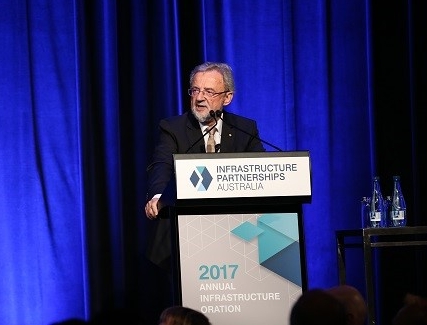
Infrastructure Oration 2017

I gave the Infrastructure Oration 2017 on Thursday night -- an annual event run by Infrastructure Partnerships Australia in conjunction with their annual awards.

My intention was to focus on the economics of infrastructure policy, but with the energy imbroglio building I found myself preoccupied again with the political, or at least political economy, issues that are bedevilling public policy in that and other areas.

That an energy crisis induced by government regulation is being blamed on the private sector is a sign of the times I guess. But it is part of a pattern of poor policy development giving rise to unintended consequences from which nothing seems to be learned, leading to further rounds of poor policy. Such dysfunction is commonly attributed to the 24/7 media and the ‘toxic politics’ that greets any government policy initiative. But these are not going to change any time soon. In fact they could well get worse. The only way we can get back onto the policy high road, it seems to me, is for government to do what it can to improve its own performance in devising good public policy and ‘selling’ it effectively.  As noted also in my previous presentation below, there is plenty of scope to do better before we abandon hope!

My paper can be found HERE, and is listed with others in the ‘publications/speeches’ section of this website.

Of Lists Undone …

In stepping down as Chief Executive of ANZSOG, I have bought myself more time to spend thinking and writing about public policy -- with fewer constraints on what I can say.  (This is the first in a policy commentary series.)

An early opportunity came with an invitation from Greg Lindsay at the Centre for Independent Studies to speak at one of their ‘leadership lunches’. This took place on 2 March at their pleasant new premises on Macquarie Street.

The assignment was to revisit the ‘to do list’ of reforms I compiled in 2012 prior to leaving the Commission. This had been prompted by a remark by Glenn Stevens that if governments really wanted to do something about Australia’s failing productivity performance, there were many suggestions in Productivity Commission reports and they should simply ‘go get the list and do them’. My ‘to do list’ sought to make this a little easier.

However it came as no surprise to find that, five years later, very few items have been ticked off, even partially. There have been some isolated advances, such as the decision to finally stop throwing good money after bad at the assembly operations of foreign auto companies (amounting to over $30 billion dollars from Australian taxpayers in the past two decades alone). But these tended to be offset by counter examples (such as the procurement of those costly and untried homemade submarines – 12 for the price of 24). The real priorities on the productivity reform list, like workplace regulation and taxation, have stood still or gone backwards.

Meanwhile, a variety of policies introduced since then are candidates for future reform, including ever-rising renewable energy targets and subsidies: through which our governments have collectively managed to sabotage Australia’s comparative advantage in low cost, reliable energy – for negligible (or, properly assessed, negative) environmental benefit.

Most of my talk -- Of lists undone: too hard or not trying?--  explored why there has been so little real reform in this new century, and so much poor policy instead. I could think of only three possible reasons: (a) ‘institutional amnesia’ (the subject of Laura Tingle’s Quarterly Essay), (b) tougher politics or (c) weaker policy capability. While there have been signs of all three forces at work, the last of them in my view is the underlying problem. A loss of policy capability within government – Commonwealth and State -- is palpable and multidimensional. It has emerged over the past 10-15 years under a style of government mercilessly but accurately lampooned in The Hollowmen TV series. A ‘Washminster’ hybrid that is proving antithetical to properly-informed policy.

Yet, if this diagnosis is correct, there is hope. Unlike the adverse changes evident in our parliaments and media, changes which are arguably reflective of changes in society itself, the decline in capability is not irreversible. Unless it is turned around, however, we cannot tell whether reform has truly become ‘too hard’, as many now seem to assume.

Improvements to the policy-making system have become an essential pre-condition for improvements in policy itself. As a close observer of this system, I am accordingly proposing two further ‘to do lists’ that, with effective leadership, seem eminently achievable and would make a significant difference: one focussed on the bureaucracy, the other on Ministers and their offices.

I will elaborate in a forthcoming publication. (Meanwhile a video of my presentation is available HERE.)